
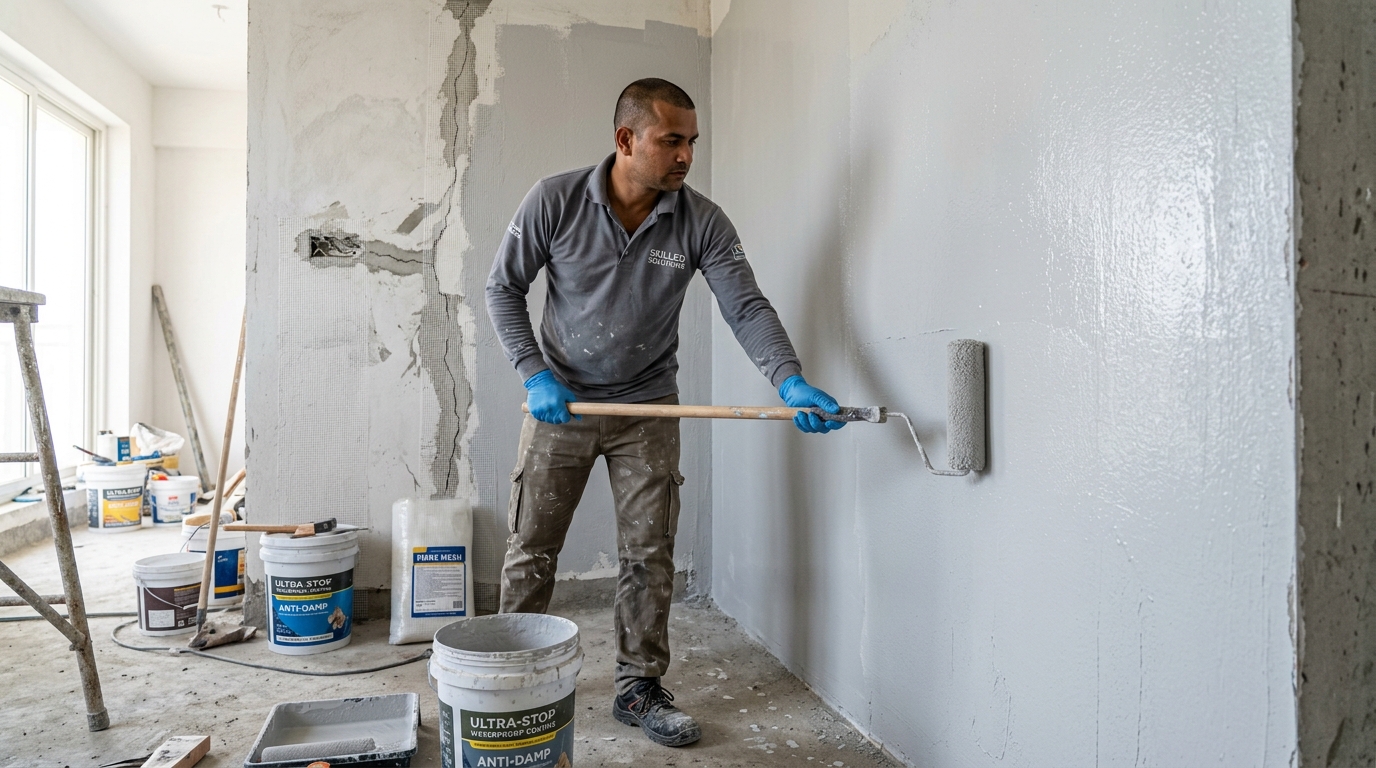
Every year after the monsoon in Jharkhand (July through September), thousands of homeowners across Jamshedpur notice the same frustrating sight: fresh paint bubbling, walls developing ugly damp patches, and a white powdery substance (efflorescence or shora) flaking off skirting boards.
Most local painters simply scrape the surface, apply ordinary wall putty, and repaint over it. Within 60 to 90 days, the moisture pushes through again, destroying the new paint.
Paint is a decorative skin; it is not a water dam. If moisture is trapped behind the plaster, no amount of luxury paint will stick. Here is the engineering protocol to diagnose and permanently solve wall seepage before you paint.
1. The Three Common Causes of Wall Dampness
A. Rising Dampness (Ground Moisture)
Occurs on ground floor flats and villas up to 3 to 4 feet from the floor level. Moisture from the soil rises through the foundation brickwork via capillary action because the original Damp Proof Course (DPC) has failed or was never installed.
B. Rainwater Seepage through Exterior Micro-Cracks
During heavy thunderstorms in the Chota Nagpur plateau, wind-driven rain hits building exterior facades. Hairline cracks as thin as 0.5mm act as funnels, drawing water into the brick core, which then migrates to the inside living room walls.
C. Concealed Pipe Leakage & Adjoining Bathroom Tile Joints
If dampness appears in a specific vertical streak behind a bathroom wall, wardrobe, or kitchen sink, water is penetrating deteriorated grout lines or leaking from concealed CPVC/GI plumbing fittings.
⚠️ Never Paint a Wall with Moisture Exceeding 12%: Before applying primer, professional contractors use a digital moisture meter (protimeter). If substrate moisture exceeds 12%, paint failure is virtually guaranteed.
2. The 4-Step Permanent Waterproofing Protocol
-
Excavation to Bare Masonry:
Do not just scrape the paint! The decayed plaster and salt deposits must be hacked down to the brickwork or bare concrete, extending at least 1 foot beyond the visible damp zone. -
Salt Neutralization & Surface Sterilization:
Wash the exposed masonry with a specialized efflorescence neutralizer or mild muriatic acid solution (1:10 dilution with water) to dissolve mineral salts. Let the wall dry completely. -
Application of 2-Component Polymer Elastomeric Barrier:
Apply two cross-directional coats of a polymer-modified elastomeric waterproof membrane such as Dr. Fixit Fastflex or Berger Dampstop Advanced. This creates an impenetrable hydrostatic barrier capable of withstanding up to 4 bars of water pressure. -
Waterproof Putty & Breathable Primer:
Re-plaster the section using sand-cement mortar mixed with an integral waterproofing compound (e.g. Dr. Fixit LW+). Finish with white cement-based waterproof putty and a penetrating moisture-resistant primer prior to topcoat emulsion.
3. Roof & Terrace Protection: The True Shield
For top-floor flats and bungalows, ceiling dampness around fan hooks and cornice corners is caused by standing terrace water.
Instead of traditional brickbat coba (which cracks and adds dead weight), modern architectural waterproofing utilizes a seamless elastomeric PU roof membrane (such as Dr. Fixit Raincoat or Berger WeatherCoat Kool & Seal). This expands and contracts during extreme summer temperatures (45°C in Jamshedpur) and provides an unbroken seamless barrier against monsoon pooling.
| Waterproofing Problem | Wrong Quick-Fix | Permanent Engineered Solution |
|---|---|---|
| Lower Wall Efflorescence (Shora) | Scraping & ordinary acrylic putty | DPC injection + 2-component polymer barrier (Dr. Fixit Fastflex) |
| Exterior Facade Hairline Cracks | Standard paint application | Elastomeric crack filler + PU WeatherShield coating (Apex Protek) |
| Terrace Roof Leakage | Cement slurry coat (chuna / neeru) | Fiber-reinforced elastomeric roof membrane (10-year warranty) |
Suspecting Wall Dampness in Your Home?
Do not paint over it! Book a free moisture assessment with our senior waterproofing engineers in Bistupur. We will inspect your walls using digital moisture meters and recommend permanent solutions.